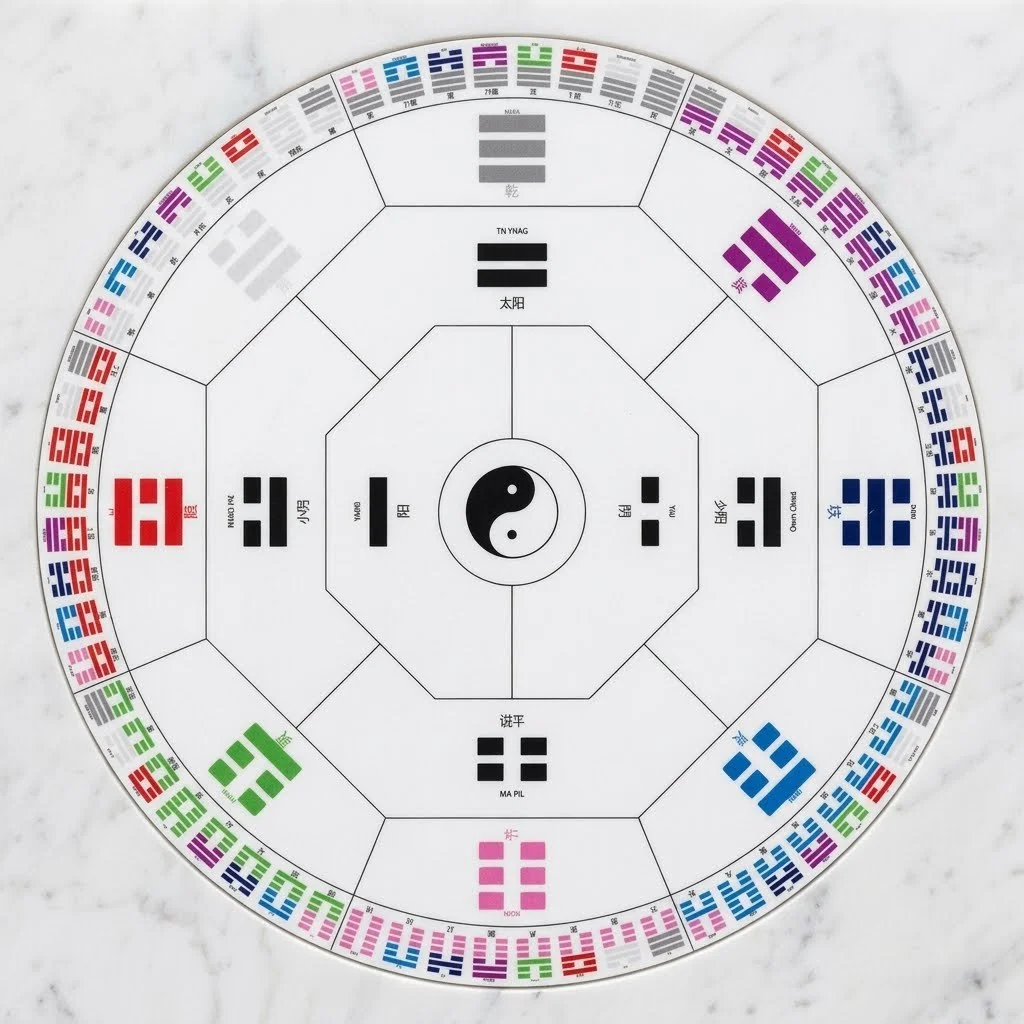
THE SPATIAL MATRIX ENGINE
A Tri-System Methodology for Large-Scale Spatial Transformation
"The purpose of truly transcendent art is to express something you are not yet, but something that you can become."
— Ken Wilber
Bob Eige Studio introduces a groundbreaking approach to the creation of monumental, large-scale environmental art. By synthesizing ancient binary mechanics, evolutionary neuro-aesthetics, and modern transpersonal philosophy, we evaluate a master dataset of 96 images to engineer environments built for total cognitive transformation.
We cross-examine every composition through three distinct algorithmic pillars to isolate and deploy artwork that actively alters human consciousness and harmonizes complex spatial structures.
PILLAR 1: THE LENS ALGORITHM
Integral Theory & Aperspectival Transparency
The Lens Algorithm maps each artwork against the structural developmental layers of Ken Wilber’s Integral Theory and Jean Gebser’s evolutionary consciousness models. This evaluation guarantees that a space is structurally and philosophically aligned with high-level cognitive expansion.
Integral Consciousness Mapping: Artworks are tiered according to their transpersonal resonance—ranging across Etheric/Vision-Logic, Astral, Subtle, Causal, Non-Dual, and a dedicated Non-Transpersonal tier reserved for pure formal aesthetics and structural geometry.
Gebserian Aperspectival Transparency: Compositions are audited for multidirectional awareness and the multi-dimensional folding of space. This breaks the viewer out of rigid, one-dimensional perspective traps and invites them into open-ended, lateral clarity.
PILLAR 2: NEURO-AESTHETIC AUDITING
The State Optimization Score (SOS)
True neuro-aesthetic valuation occurs when abstract generative art is grounded within the universal, evolutionarily hardwired baseline of human cognitive decompression. The brain naturally relaxes when it encounters properties that mimic a safe, expansive natural environment. Every piece in our library is assigned a data-driven State Optimization Score (SOS) from 1 to 10 based on three hardwired pillars:
Geometric Complexity: Auditing line rhythms, computational pathways, and structural grids to engage high-level pattern recognition without inducing fatigue.
Color Psychology: Assessing the neurological impact of the palette, balancing grounding, low-arousal tones (like indigos and putty greys) against precise, high-frequency energetic stimulants.
Fractal Depth: Measuring statistical mathematical fractals and low-spatial-frequency soft-focus gradients. These structures signal safety to the nervous system, dropping the viewer from states of high stress into deep, restful focus.
PILLAR 3: THE I-CHING MATRIX
Ancient Binary Code & Cosmic Systems Conjunction
The I-Ching (Book of Changes) is humanity’s earliest deep neural network—a cosmic system built entirely on binary code, structural transitions, and spatial matrices. By mapping the library directly to the 64 hexagrams, we weave mathematical timelessness into modern digital brushstrokes.
Symbiosis & Conjunction: The binary trigrams evaluate how rigid, unyielding spatial infrastructure (such as solid stone or architectural grids) gracefully interfaces with fluid, unpredictable data streams (such as shifting light or liquid ripples).
System Equilibrium: This framework ensures that structural order and organic chaos actively coexist, creating an art installation that acts as a living, breathing ecosystem within a corporate setting.