THE SPATIAL MATRIX FINE ART LIBRARY & CURATORIAL ENGINE
Architectural Scale Sourcing
Modern corporate workspaces face a compounding crisis of intellectual burnout, environmental confinement, and cognitive fatigue.Bob Eige Studio addresses these critical spatial challenges at scale. The Spatial Matrix Fine Art Library is a specialized, proprietary collection of 96 master artworks, curated to transform restrictive commercial interiors into restorative, high-performance environments.
Rather than serving as passive decoration, this collection leverages principles of human visual biology and environmental psychology. Each work is digitally sculpted to introduce geometric depth and then fabricated onto architectural-scale ChromaLuxe Dye-Sublimation Aluminum Panels via Mxxxx Cxxxx. Using the Spatial Matrix Curatorial Engine artworks are evaluated and curated across three distinct structural baselines (pillars). Thus our procurement framework allows interior architects, corporate designers and art curators to deploy tailored visual systems that complement the cognitive demands of the workforce.
PILLAR 1: PHYSICAL STABILIZATION (The Body Baseline)
Our physical baseline focuses on how the structural visual properties of an artwork interact with a viewer's immediate environment, eye mechanics, and physical comfort.
The Somatic Decompression Index (SDI)
Every master artwork is classified on a functional 1–10 tuning scale based on its calculated visual intensity.
This index serves as a data-driven placement guide for interior architects to match an artwork's visual weight to a workspace's specific operational needs. Before calculating these placement tiers, the system routes the raw asset data through our Analytical Sub-Metrics matrix, mapping high-level Fractal Density Profiles and dynamic Fractal Movement Vectors to mathematically measure how eye fatigue is physically mitigated.
Once these visual strain variables are balanced, the artwork is deployed across its optimal structural bandwidth:
Low Tiers (SDI 1–4) / High-Stimulation Zones: Vibrant, high-energy compositions designed to complement active focus and creative tension. Optimal for innovation war-rooms, collaborative labs, and ideation hubs.
Mid Tiers (SDI 5–7) / Active Focus Zones: Balanced compositions that invite steady engagement without causing distraction, supporting long-term productivity. Optimal for open-plan workstations, executive suites, and main corridors.
High Tiers (SDI 8–10) / Restorative Zones: Grounding visual fields featuring wide, calm layouts and vast rest zones. Optimal for high-compute engineering spaces, crisis rooms, and dedicated employee wellness sanctuaries.
PILLAR 2: COGNITIVE DECOMPRESSION (The Mind Baseline)
Our mental baseline applies established environmental psychology and neuro-aesthetic principles to systematically relieve intellectual burnout, restore mental bandwidth, and visually expand tight spaces.
Attention Restoration & Soft Fascination: Grounded in Stephen and Rachel Kaplan’s Attention Restoration Theory (ART), our imagery utilizes "soft fascination." While rigid office geometry overworks the brain's analytical networks, organic visual patterns hold interest effortlessly. This allows the executive-functioning networks to recover from screen fatigue while supporting the brain's Default Mode Network (DMN).
The Science of Visual Depth (The Taylor Retina Convergence): Research by Dr. Richard Taylor (University of Oregon) demonstrates that geometric fractal patterns natively found in nature match the branching, fractal structures of the human retina. Our Mandelbulber rendering engine leverages this hardwired connection to calculate and digitally sculpt these specific mathematical formulas into three-dimensional structures, facilitating an environmental down-regulation of stress markers.
Spatial Correction for Windowless Environments: Blank walls and tight architectural footprints create an underlying sense of confinement. Our artwork acts as a high-resolution visual window, utilizing multi-layered depth perspective, atmospheric receding space, and precise color theory to psychologically expand the perceived volume of windowless rooms.
The 10 Core Neuro-Aesthetic Triggers
The engine correlates color psychology and structural geometry across ten distinct visual anchors:
Dappled Light Textures (Komorebi): Intricate organic light textures overlaid across structural fields to mimic natural forest canopies, gently stabilizing retinal strain and lowering eye tension.
Soft-Focus Chromatic Fields: Edge-softened, fluid color gradients that allow the visual cortex to rest, triggering immediate mental decompression and active stress relief.
High-Horizon Vistas: Vast horizontal baselines providing an intuitive biological sense of open, safe environmental depth—ideal for establishing open perspective in confined architectural zones.
Atmospheric Receding Space: Multilayered, deep-contrast shifts that recreate natural landscape tracking, psychologically breaking down wall barriers and expanding small or windowless interior footprints.
Calming Warm Tones: Low-frequency ambers, ochres, and muted earth tones that signal biological safety to the nervous system, dropping heart rates and grounding high-stress office environments.
Ordered Geometric Symmetry: Algorithmic structures mimicking the golden ratio and Fibonacci frameworks to provide effortless spatial prediction, giving the brain an immediate sense of structural order and stability.
Fluid Kinetic Transitions: Shifting, organic visual paths that gently guide the eye through space, capturing "soft fascination" to recharge an employee's focused attention without causing analytical fatigue.
Reflective Light Dynamics (Caustics): Shifting light patterns that mimic water and fluid movement, sending deep evolutionary signals of environmental safety and resource abundance to the brain's emotional center.
Micro-Fractal Texturing: High-density, natural surface detailing (mid-range fractal density) that offers rich visual texture and environmental stillness without using aggressive, sharp lines.
Undulating Minimalist Curves: Wide, clean sweeping sweeping formats that smoothly draw the eye across a room, creating a seamless visual flow that eliminates spatial clutter.
PILLAR 3: EVOLUTIONARY CONSCIOUSNESS & COGNITIVE EXPANSION (The Spirit Baseline)
Our cultural baseline ensures that the artwork supports advanced creative problem-solving and a progressive enterprise culture.
The sequence maps spatial assets directly against the structural developmental layers of Ken Wilber’s Integral Theory and Jean Gebser’s evolutionary consciousness structures, creating a visual environment that aligns with non-linear cognitive growth, enterprise cultural maturity, and aperspectival transparency.
Artworks are programmatically layered across an ascending 6-Stage Integral Spectrum:
Level 1: Formal-Reflexive / Mental-Rational Baseline
Rigid, rational, highly logical, and linear visual forms. This stage aligns with Wilber’s formal-operational cognitive layer and Gebser's perspective-bound Rational structure, establishing the traditional, hyper-focused mental scaffolding of conventional engineering.Level 2: Vision-Logic / Aperspectival Integral Structure
The postformal integration of paradox. By presenting aperspectival visual structures that hold apparent contradictions—such as fluid organic curves paired with rigid, chiseled architectural blocks—in a single field, this stage aligns with Wilber's Vision-Logic (Centauric) cognitive stage and Gebser's Aperspectival Integral structure. It pulls engineering and leadership cohorts out of rigid, linear cognitive loops into systemic, multi-dimensional, and transparent vision-logic.Level 3: The Psychic Level (Nature Mysticism)
The initial transpersonal transition into worldcentric and cosmic networks. This stage aligns with Wilber’s Psychic Level, where awareness expands into a direct, transrational identification with the biosphere (Nature Mysticism). Compositions evoke profound biophilic interconnectedness, expanding operational awareness into macro-systems and structural ecological patterns.Level 4: The Subtle Level (Deity Mysticism)
Transition into trans-spatial archetypes, trans-verbal illumination, and luminous, atmospheric geometries. Aligning strictly with Wilber's Subtle Level (Deity Mysticism), these visual fields capture structural patterns and subtle energy matrices before they take dense physical shape, supporting intuitive clarity and creative capacity.Level 5: The Causal Level (Formless Mysticism)
The threshold of radical, unmanifest negative space, unmanifest ground, and pristine voids. Aligning with Wilber's Causal Level (Formless Mysticism), this stage anchors space in a state of absolute, unmanifest silence, providing a visual baseline to mitigate executive brain fatigue and support deep cognitive reserves.Level 6: Non-Dual Integration
The ultimate synthesis where form and formlessness seamlessly merge. Aligning with Wilber's Non-Dual reality, the spatial asset moves beyond an external object of perception and is positioned as the absolute, ever-present Ground of the integrated workplace architecture itself.
THE INTEGRATION OF SOMATIC, COGNITIVE, AND TRANSPERSONAL SPACE
The ultimate capacity of the Spatial Matrix Curatorial Engine is realized when an artwork row from our 96-image dataset is evaluated through all Three Foundational Pillars of the architecture simultaneously.
By mapping raw computational visuals across the Physical Stabilization Axis (Pillar 1), the Cognitive Decompression Axis (Pillar 2), and the Transpersonal Innovation Axis (Pillar 3), the engine transcends traditional design approaches.
It synthesizes hardwired biological stress regulation, advanced neuro-aesthetic spatial correction, and progressive cognitive evolution into a single, cohesive spatial reality. The result is an architectural environment built to house human teams while aligning with and supporting the creative consciousness of the workforce within it.
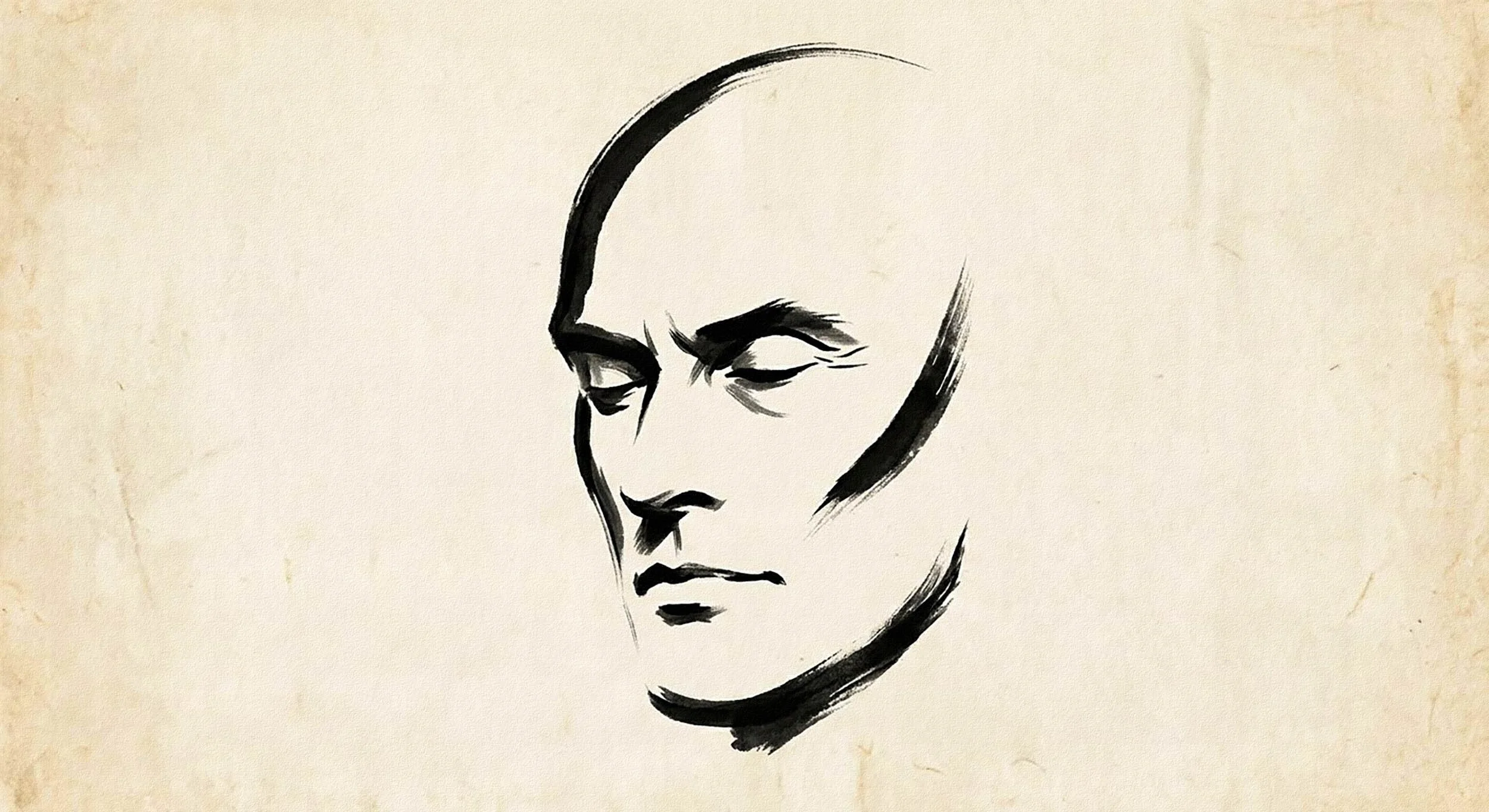
Portrait of Ken Wilber, image prompts and enhancement by Bob Eige, brush stroke painting by Gemini AI
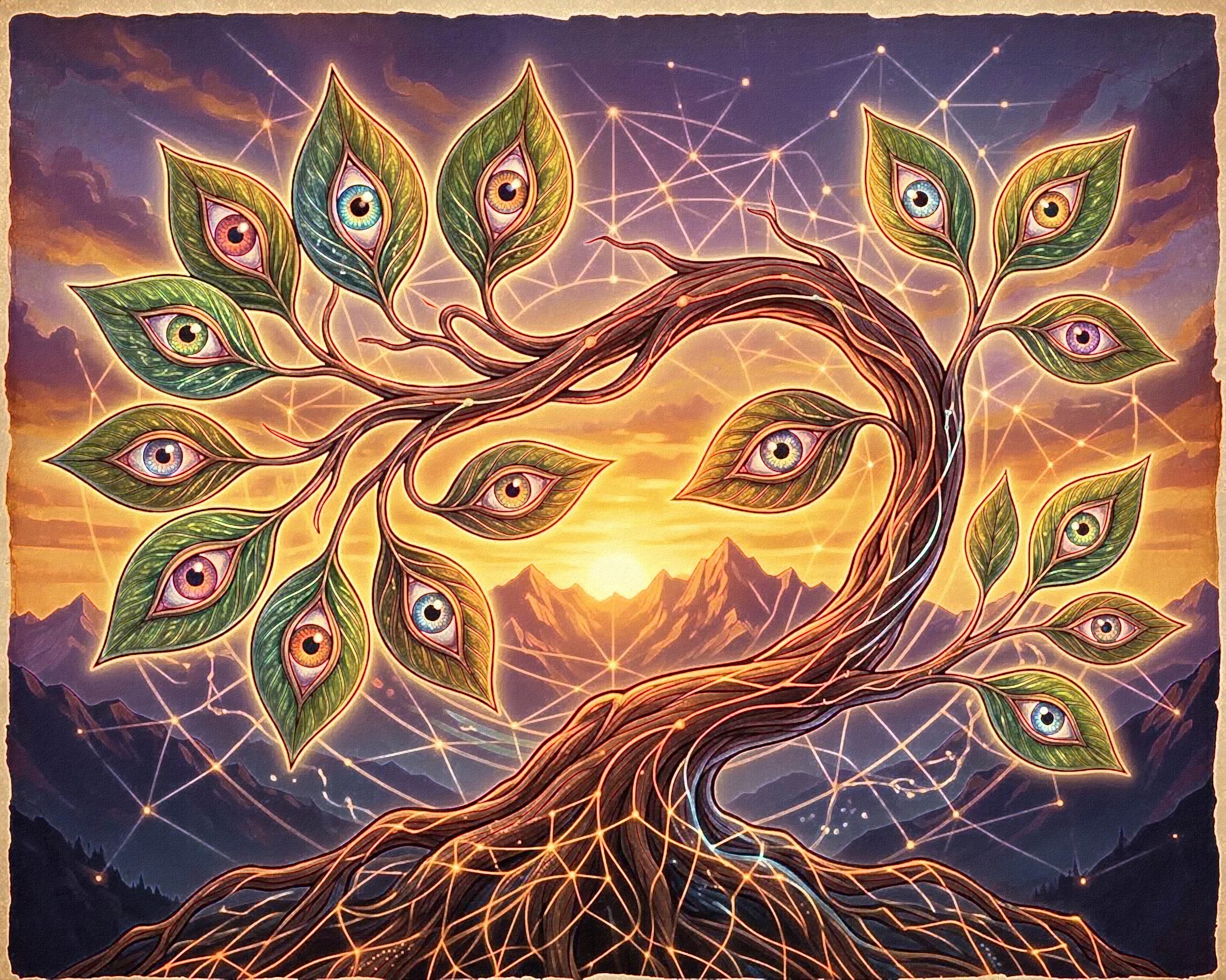
Dawn of the Emerging World, (visual metaphor for neuro-aesthetics) concept, image prompts, and enhancement by Bob Eige, painting by Gemini AI
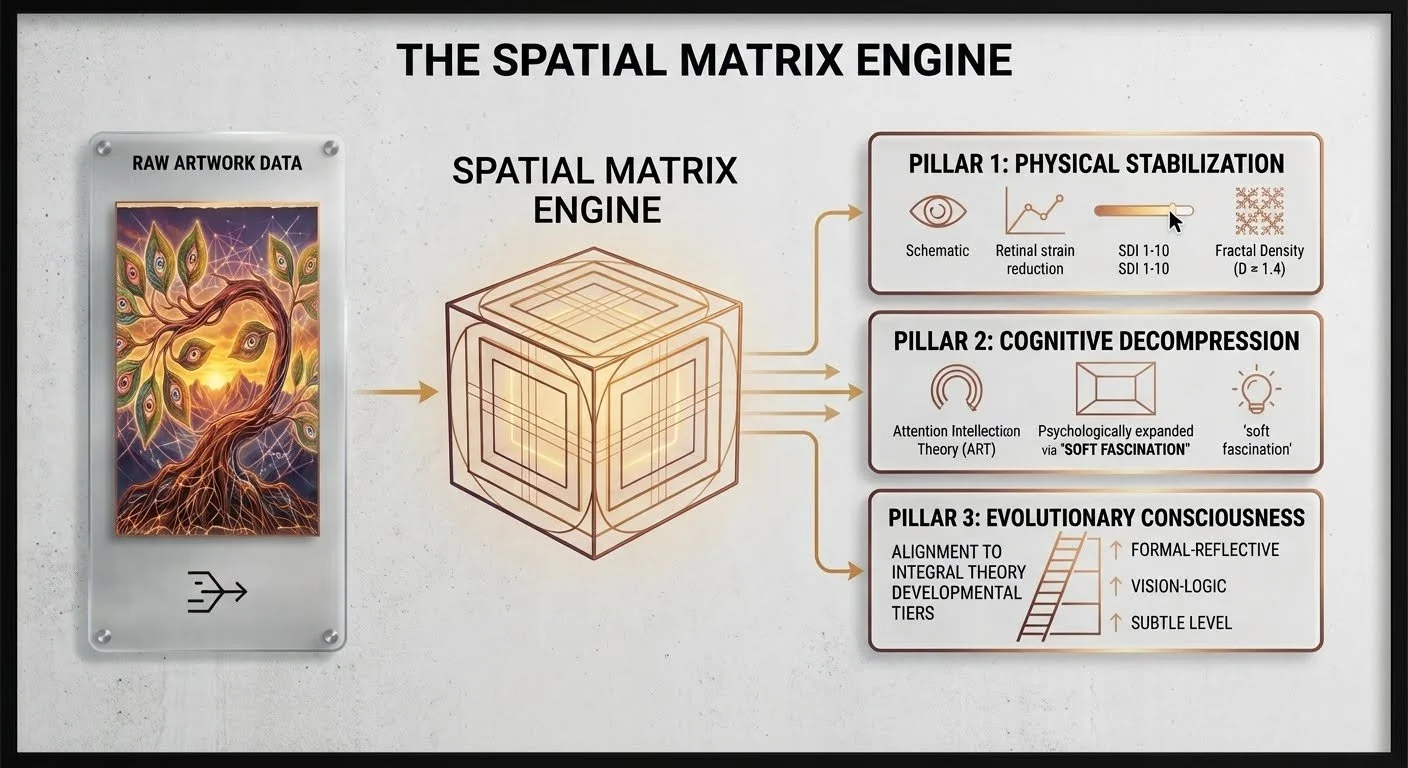
Graphic representation No. 1: The Spatial Matrix Engine. Concept and image prompts by Bob Eige, image creation by Gemini AI
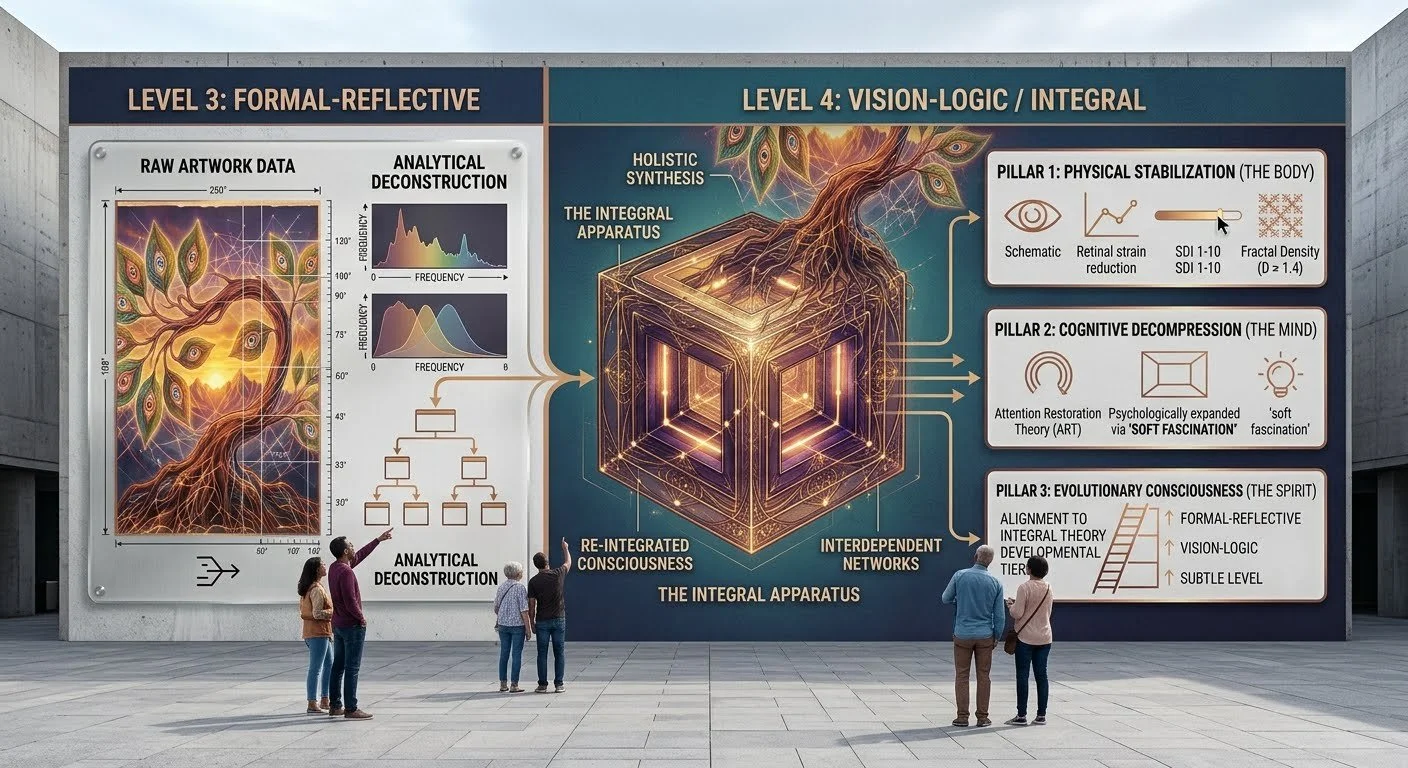
Graphic Representation No. 2: The Spatial Matrix Engine - Focus on Assessment of Transperson Levels. Image prompt by Bob Eige, image creation by Gemini AI.